
Selfoptimizing-what we are doing
- Selfoptimizing-what we are doing
- V1 - erste Problemstellung
- 1. Sharp positioning
- 2. Problem–Solution Fit options
- 3. Best early customer segment
- 4. Strong business models
- 5. Business Model Canvas — recommended starting model
- 6. Concrete offer packages
- 7. Example problem–solution fits to test first
- 8. What to build first
- 9. Recommended go-to-market
- 10. Best initial business model
- 11. Key risks
- Final recommendation
- V2 - zweite Problemstellung
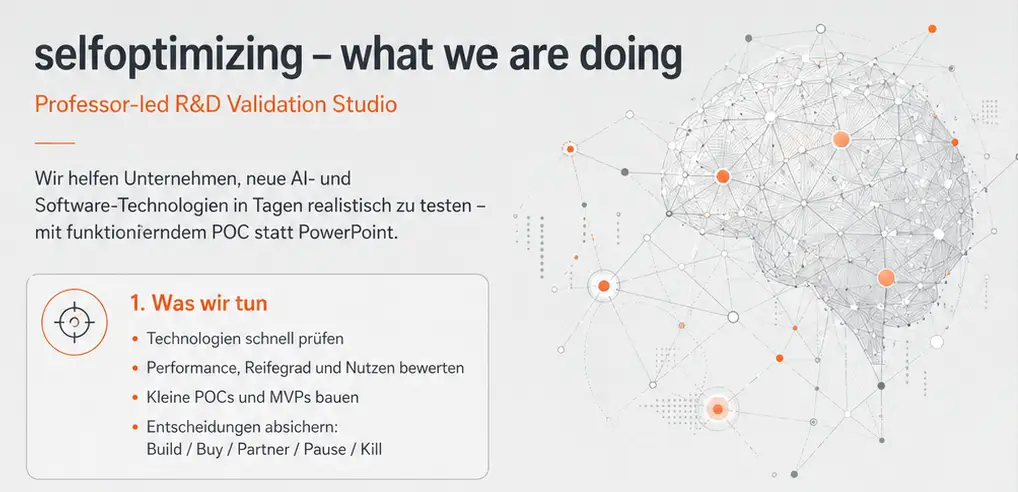
Selfoptimizing-what we are doing
Eine Analyse, was wir gerne tun und wer dafür wohl bereit zu bezahlen ist …
V1 - erste Problemstellung
analyse solution and show results for some psf, cusomersegments and bms : power R&D Expert performace tool and technologiy checker : fast checking and testing technologoes and start smal cases poc / mvps for customers, professor in cs as lead , how to monetise , build some problems - solution fits, identifiy cusomer segments and ubild then som business models , show in bmc - ba accurate, tae your time, be consise .
Assumption: PSF = Problem–Solution Fit, BMs = business models, BMC = Business Model Canvas. Your idea is: a professor-led R&D expert tool/service that rapidly checks technologies, tests performance, and launches small POCs/MVPs for customers.
| Core principle: start with small, measurable MVPs, because Lean Startup emphasizes solving a real problem first, then using MVPs and build–measure–learn feedback loops to validate learning quickly. ([The Lean Startup](https://theleanstartup.com/principles?utm_source=chatgpt.com “The Lean Startup | Methodology”)) For technology assessment, use a maturity scale like TRL 1–9, where TRL measures how mature a technology is, from early principles to proven operational use. (NASA) |
1. Sharp positioning
Best positioning:
“Independent R&D validation lab for companies that need to decide fast whether a technology is worth buying, building, funding, or killing.”
Do not position first as a generic “AI/tech consulting firm.” Too broad.
Better wedge:
“We help technical and business leaders validate emerging technologies in 2–6 weeks through expert review, benchmarks, POCs, and MVPs.”
2. Problem–Solution Fit options
| # | Customer segment | Pain/problem | Your solution | MVP/POC offer | PSF strength |
|---|---|---|---|---|---|
| 1 | SMEs / Mittelstand | They hear about AI, automation, digital twins, LLMs, edge/cloud tools but do not know what is real, useful, or affordable. | Fast independent technology checker + small POC. | “AI/Tech Opportunity Sprint”: 2 weeks, 3 use cases, 1 tested mini-demo. | High |
| 2 | Corporate R&D / innovation teams | Too many tech ideas, vendors, pilots; hard to decide what to kill or fund. | Structured tech assessment, benchmark, TRL-style scoring, POC roadmap. | “Technology Readiness & Vendor Benchmark Report.” | Very high |
| 3 | Startups / scaleups | Need credible technical validation for investors and enterprise buyers. | Professor-led independent technical due diligence and performance report. | “Investor-ready Technical Validation Pack.” | High |
| 4 | Investors / VCs / family offices | They cannot deeply evaluate technical risk before investing. | Technical due diligence, architecture review, risk scoring. | 5–10 day expert review before deal decision. | High margin |
| 5 | Universities / research groups | Good research, weak commercialization path. | Market-fit testing, prototype packaging, MVP experiments. | “Research-to-MVP Commercialization Sprint.” | Medium |
| 6 | Public sector / grants / NGOs | Need trustworthy tech evaluation before procurement or funding. | Independent evaluation framework and pilot design. | “Technology Feasibility Study.” | Medium, slower sales |
3. Best early customer segment
Start with Corporate R&D / innovation teams and technical SMEs.
Why: they already have budget, real problems, and urgency. They also value credibility from a CS professor as lead. The Business Model Canvas is useful here because it helps describe, design, challenge, and pivot the business model. (Strategyzer)
4. Strong business models
| Business model | What you sell | Pricing logic | Good for |
|---|---|---|---|
| Diagnostic sprint | 1–3 week technology check | Fixed fee: €5k–€25k | Entry product |
| POC/MVP sprint | Build and test small prototype | Fixed fee: €15k–€75k | Main revenue |
| R&D retainer | Monthly expert access + testing | €5k–€30k/month | Stable revenue |
| Technical due diligence | Review tech, team, architecture, risks | €8k–€50k/report | Investors/startups |
| Benchmark subscription | Database of technology/vendor benchmarks | SaaS: €500–€5k/month | Later-stage scalable model |
| Training + certification | Teach teams how to assess tech | €2k–€20k/workshop | Brand + leads |
| Success-based commercialization | Help turn research into products | Equity/revenue share | High upside, risky |
Best sequence:
-
Sell services first: diagnostic + POC sprints.
-
Productize repeated work into templates, scoring tools, benchmark dashboards.
-
Later turn into SaaS/data platform.
5. Business Model Canvas — recommended starting model
BMC: “R&D Technology Validation Sprint”
| BMC block | Content |
|---|---|
| Customer Segments | Corporate R&D teams, innovation managers, CTOs, SMEs, startup founders, investors. |
| Value Proposition | Fast, independent validation of whether a technology is useful, mature, performant, and worth investment. Reduces wasted POCs and bad vendor decisions. |
| Channels | Professor network, LinkedIn thought leadership, university/industry partnerships, innovation hubs, VC networks, workshops, referrals. |
| Customer Relationships | Expert advisory, sprint-based delivery, recurring retainer, trusted external lab. |
| Revenue Streams | Fixed-fee diagnostics, POC/MVP builds, retainers, due diligence reports, workshops, later SaaS benchmark access. |
| Key Activities | Technology scouting, benchmarking, architecture review, prototype development, experiment design, customer problem validation. |
| Key Resources | CS professor brand, R&D experts, benchmark frameworks, test infrastructure, reusable code/tools, university talent pool. |
| Key Partners | Universities, cloud providers, labs, accelerators, VCs, industry associations, software vendors. |
| Cost Structure | Expert time, developer/researcher time, cloud/test infrastructure, sales, legal/IP, documentation, benchmark maintenance. |
6. Concrete offer packages
| Offer | Deliverable | Time | Price direction |
|---|---|---|---|
| Tech Reality Check | Problem review, vendor/tech scan, maturity score, recommendation: kill/test/build/buy | 1 week | €3k–€10k |
| POC Sprint | Working prototype, benchmark results, technical report | 2–6 weeks | €15k–€75k |
| R&D Expert Retainer | Monthly access to experts, reviews, experiments | Monthly | €5k–€30k/month |
| Investor Tech DD | Technical risk report, architecture review, team/roadmap assessment | 5–10 days | €8k–€50k |
| Professor-Led Masterclass | Training for innovation/R&D teams | 1–2 days | €5k–€20k |
7. Example problem–solution fits to test first
PSF A: Corporate AI confusion
Problem: “We have 20 AI ideas but do not know which one is valuable or feasible.”
Solution: 2-week AI use-case validation sprint.
Test: interview 10 CTOs/innovation leads.
Buying signal: they pay for a €5k–€10k diagnostic.
PSF B: Vendor selection risk
Problem: “Every vendor claims their tool is best; we need independent proof.”
Solution: benchmark 2–4 vendors against customer data and requirements.
Test: offer one benchmark report to three companies.
Buying signal: procurement or R&D budget pays.
PSF C: Startup technical credibility
Problem: “Investors/customers do not trust our technical claims.”
Solution: independent professor-led validation report.
Test: sell to 5 deep-tech/AI startups.
Buying signal: founders pay or investors request it.
PSF D: Research commercialization
Problem: “We have research but no customer-ready MVP.”
Solution: convert research into demo + commercial use-case test.
Test: partner with one university lab.
Buying signal: grant/commercialization office funds sprint.
8. What to build first
Build not a full platform, but a repeatable service toolkit:
-
Technology checker scorecard
Criteria: maturity, performance, security, integration effort, cost, IP risk, data needs, business value. -
Benchmark template
Input/output tests, latency, cost, accuracy, robustness, maintainability. -
POC playbook
Problem definition → success metric → prototype → test → decision. -
Executive report format
One-page decision: build / buy / partner / pause / kill. -
Landing page with 3 offers
“Tech Reality Check,” “POC Sprint,” “Investor Tech DD.”
9. Recommended go-to-market
Start narrow:
Target: CTOs, heads of innovation, R&D managers in industrial SMEs and tech startups.
Message: “Stop wasting months on weak POCs. We validate technologies in weeks.”
First sales motion: professor-led workshop → paid diagnostic → POC sprint → retainer.
10. Best initial business model
The strongest starting model is:
Expert-led R&D Validation Studio
Not SaaS first. Not marketplace first. Not broad consulting.
Start with paid sprints, collect repeated patterns, then turn the internal methodology into software later.
Best first revenue stack:
-
€5k–€10k Technology Reality Check
-
€20k–€50k POC/MVP Sprint
-
€8k–€25k/month R&D Retainer
-
Later: subscription benchmark platform
11. Key risks
| Risk | Mitigation |
|---|---|
| Too broad positioning | Pick one wedge: AI/automation/enterprise tech validation. |
| Professor brand too academic | Emphasize business outcomes, not only research quality. |
| Service not scalable | Standardize scorecards, reports, benchmarks, reusable tools. |
| Long enterprise sales cycles | Start with SMEs, startups, VCs, innovation teams. |
| POCs do not convert | Define success metrics before building. |
Final recommendation
Launch with this offer:
“Professor-led Technology Validation Sprint: in 2–4 weeks we test whether your target technology is technically feasible, commercially useful, and worth scaling.”
Best first customers: corporate R&D teams, technical SMEs, startups needing validation, and investors doing technical due diligence.
Best first monetization: fixed-fee diagnostics + POC/MVP sprints, then move into retainers and benchmark SaaS once patterns repeat.
V2 - zweite Problemstellung
wer wäre bereit bür diese leistung zu bezahlen - kunden segmente ? power R&D Expert performace tool and technologiy checker : fast checking and testing technologoes and start smal cases poc / mvps for customers, professor in cs as lead , how to monetise? eg. new chatbots, chatbots as organisation, how to build or solutions from scratch in short time by assisted coding , extreme codein experience and algo exerience, elgorithm eningeer
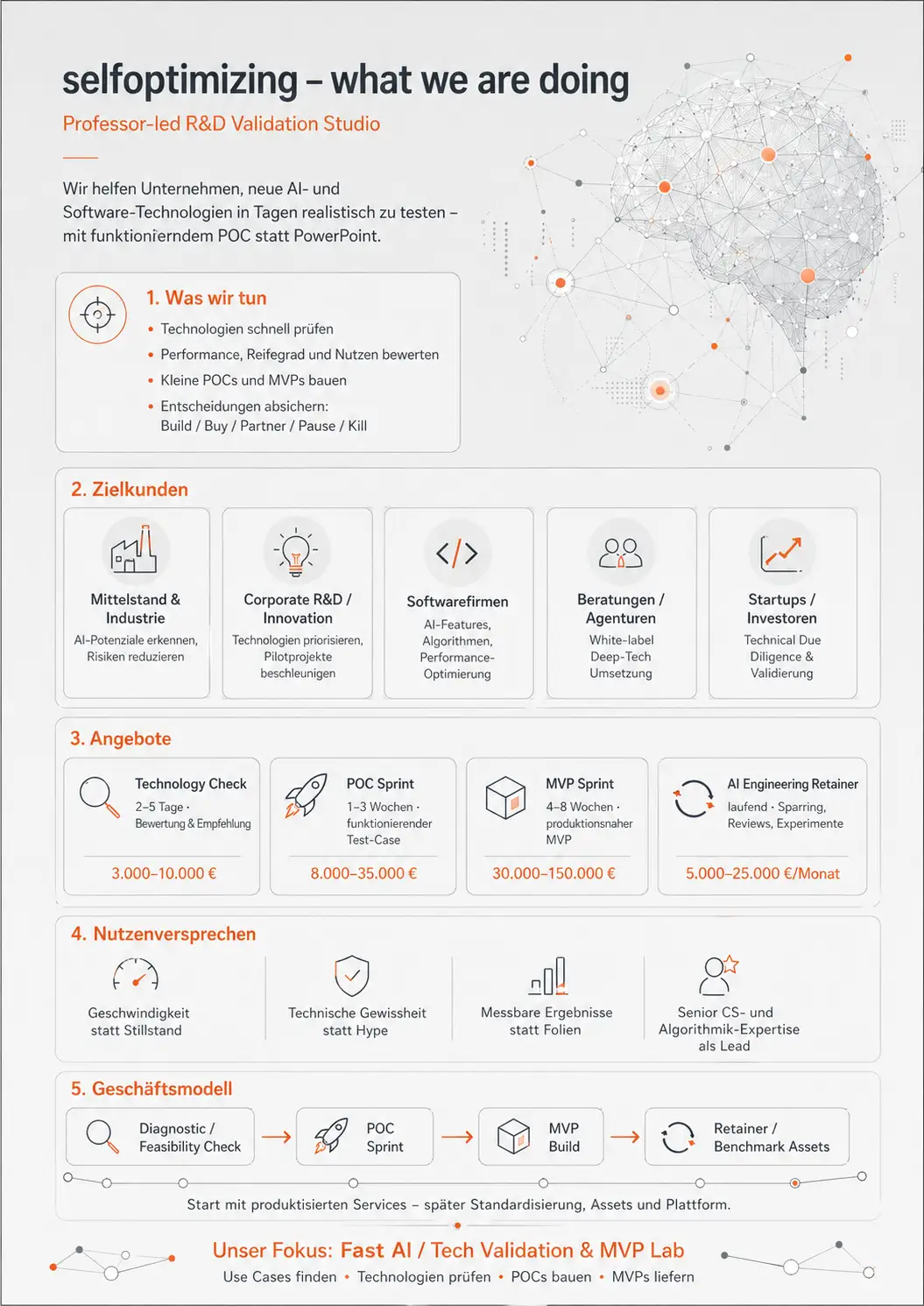
Ja — dafür gibt es zahlungsbereite Kundensegmente. Aber du solltest es nicht primär als „R&D Expert Performance Tool“ verkaufen, sondern als:
„Fast AI / Tech Validation & MVP Lab: Wir prüfen neue Technologien, bauen in Tagen erste POCs und in Wochen produktionsnahe MVPs — mit senior CS/Algorithmik-Kompetenz.“
Der Markt ist grundsätzlich da: Gartner erwartete 2025 weltweit 644 Mrd. USD GenAI-Ausgaben, +76,4 % gegenüber 2024. Gleichzeitig berichten McKinsey und Forrester, dass viele Unternehmen zwar AI/GenAI einsetzen, aber Schwierigkeiten haben, aus Piloten skalierbaren Business Value zu machen. Genau diese Lücke kann dein Angebot bedienen: schnell testen, technische Risiken reduzieren, echte Use Cases bauen. (Gartner)
Wer würde dafür bezahlen?
| Kundensegment | Warum sie zahlen | Konkretes Angebot | Zahlungsbereitschaft |
|---|---|---|---|
| Mittelstand / Industrie / Logistik / Maschinenbau | Wollen AI nutzen, haben aber keine schnellen AI-Engineers intern | AI Use Case Check, internes Chatbot/RAG-System, Prozessautomatisierung, POC | Hoch |
| Corporate Innovation Labs | Müssen neue Technologien schnell bewerten und Pilotprojekte liefern | „10-Day Tech Validation Sprint“ | Sehr hoch |
| SaaS- und Softwarefirmen | Haben technische Schulden, Performance-Probleme, AI-Features auf Roadmap | Algorithmus-Optimierung, AI Feature MVP, Assisted Coding Acceleration | Hoch |
| Beratungen / Agenturen / Systemintegratoren | Verkaufen AI-Projekte, brauchen aber tiefe technische Umsetzung | White-label R&D / Algorithm Engineering / POC Factory | Hoch |
| Startups / Gründer | Brauchen schnellen MVP, haben aber wenig Tech-Kapazität | MVP von 0 auf Demo, AI-Agent, Chatbot, Matching-Algorithmus | Mittel, manchmal Equity |
| VCs / Company Builder / M&A Teams | Müssen Technologie von Startups bewerten | Technical Due Diligence, Code-/Architecture Review, AI Feasibility Report | Hoch |
| Universitäten / Forschungsprojekte / Förderprojekte | Brauchen Transfer in Prototypen | Research-to-Prototype, grant-funded POCs | Mittel |
| Behörden / regulierte Organisationen | Wollen sichere, erklärbare AI-Use-Cases | Governance-first Chatbot, Datenschutz- und Modellvergleich | Hoch, aber langsamer Sales |
Die besten ersten Zielkunden
Ich würde nicht bei allen gleichzeitig starten. Die attraktivsten Segmente sind:
1. Mittelständische Unternehmen mit digitalem Druck
Zum Beispiel Maschinenbau, Logistik, Healthcare-Dienstleister, Energie, Versicherungsnahe Dienstleister. Sie haben viele repetitive Wissensprozesse, Dokumente, Supportfragen, interne Daten und Fachwissen — aber oft keine starke AI-R&D-Abteilung.
Kaufgrund:
„Wir wissen, AI ist wichtig, aber wir wissen nicht, welcher Use Case wirklich lohnt.“
Verkaufsangebot:
AI Opportunity & POC Sprint
In 2–3 Wochen: Use Cases finden, priorisieren, einen funktionierenden POC bauen.
2. Softwarefirmen mit AI-Roadmap
Diese Kunden verstehen Tech und zahlen schneller, wenn du nachweisen kannst, dass du Geschwindigkeit oder Qualität erhöhst.
Kaufgrund:
„Wir müssen AI-Features liefern, aber unser Team ist ausgelastet.“
Verkaufsangebot:
AI Feature Acceleration Sprint
Chatbot, Copilot, Agent, Semantic Search, Code Assistant, Recommendation Engine, Optimierungsalgorithmus.
3. Beratungen und Agenturen als Partner
Viele Beratungen verkaufen AI-Strategie, aber haben nicht genug echte Builder. Du kannst als technischer Deep-Tech-Partner auftreten.
Kaufgrund:
„Wir brauchen jemanden, der das tatsächlich baut.“
Verkaufsangebot:
White-label AI Engineering Partner
Du baust POCs/MVPs im Hintergrund, die Beratung hält die Kundenbeziehung.
Was genau wird monetarisiert?
Nicht „Zeit“ verkaufen, sondern Risiko-Reduktion + Geschwindigkeit + technische Gewissheit.
Deine Kernprodukte könnten so aussehen:
| Produkt | Dauer | Preisidee |
|---|---|---|
| Technology Checker Report | 2–5 Tage | 3.000–10.000 € |
| AI Use Case Discovery Workshop | 1 Tag | 2.000–6.000 € |
| POC Sprint | 1–3 Wochen | 8.000–35.000 € |
| MVP Sprint | 4–8 Wochen | 30.000–150.000 € |
| Algorithm / Performance Rescue | 1–4 Wochen | 10.000–60.000 € |
| AI Engineering Retainer | monatlich | 5.000–25.000 €/Monat |
| Executive / Developer AI Training | 0,5–3 Tage | 3.000–20.000 € |
Die höheren Preise bekommst du eher bei B2B-Kunden, nicht bei kleinen Startups.
Besonders starke Use Cases
Für dein Profil — Professor CS Lead, Algorithm Engineering, extreme Coding Experience, Assisted Coding — passen besonders:
Interne Wissens-Chatbots / RAG-Systeme
Für Dokumente, Handbücher, Tickets, PDFs, SharePoint, Confluence, CRM.
Organisation als Chatbot-System
Nicht ein Chatbot, sondern mehrere Rollen-Bots: HR-Bot, Sales-Bot, Support-Bot, Engineering-Bot, Management-Bot.
Tech Feasibility Check
„Kann man das mit LLMs, Agents, Computer Vision, Optimization, Graph Algorithms oder RAG sinnvoll lösen?“
Assisted Coding Acceleration
Teams lernen, mit AI deutlich schneller zu entwickeln: Codebase verstehen, Refactoring, Tests, Prototypen.
Algorithm Engineering / Optimization
Routenplanung, Scheduling, Matching, Ranking, Simulation, Performance-Tuning.
AI MVP from Scratch
Von Idee zu Demo: Architektur, Backend, Frontend, Datenpipeline, Modellvergleich, Deployment.
Positionierung, die Käufer verstehen
Nicht:
„Power R&D Expert Performance Tool and Technology Checker“
Besser:
„Wir helfen Unternehmen, neue AI- und Software-Technologien in 10 Tagen realistisch zu testen — mit funktionierendem POC statt PowerPoint.“
Oder stärker:
„Deep-Tech MVP Lab für AI, Chatbots, Agents und Algorithm Engineering — geführt von CS-Professoren und Senior Engineers.“
Oder für Mittelstand:
„Ihr schneller AI-Technikpartner: Use Case finden, Technologie prüfen, POC bauen, MVP liefern.“
Geschäftsmodell
Ich würde mit productized consulting starten, nicht sofort mit SaaS.
Phase 1: Dienstleistung mit klaren Paketen
Technology Check, POC Sprint, MVP Sprint.
Phase 2: Wiederverwendbare Assets bauen
RAG-Starterkit, Evaluation Framework, Agent Templates, Security Checklist, Prompt/Test Suites.
Phase 3: Retainer und Plattform
Kunden zahlen monatlich für kontinuierliches AI-R&D, Monitoring neuer Technologien, kleine Experimente und MVP-Erweiterungen.
Phase 4: Softwareprodukt
Aus wiederkehrenden Projekten entsteht eventuell ein eigenes „Technology Checker / POC Automation Tool“.
Der beste Einstiegssatz für Sales
„Welche AI- oder Tech-Idee liegt bei Ihnen seit Monaten auf dem Tisch, weil niemand Zeit hat, sie sauber zu testen? Wir bauen Ihnen in 10 Arbeitstagen einen belastbaren POC und sagen ehrlich, ob es sich lohnt.“
Das ist stark, weil es nicht Hype verkauft, sondern Entscheidungssicherheit.
Meine Empfehlung
Starte mit drei Angeboten:
-
AI / Tech Feasibility Check — günstiger Einstieg, 3.000–10.000 €.
-
10-Day POC Sprint — Kernangebot, 10.000–35.000 €.
-
MVP Build Sprint — Premiumangebot, 40.000–150.000 €.
Die beste Zielgruppe am Anfang: mittelständische Unternehmen mit konkreten Prozessproblemen + Softwarefirmen mit AI-Feature-Druck + Beratungen als Vertriebspartner.